
Large structure monitoring is one of the most active fields of fiber grating sensors. The measurement of mechanical parameters is very important for the maintenance and health monitoring of Bridges, mines, tunnels, DAMS, buildings, etc. By measuring the strain distribution of the structure, the local load and health of the structure can be predicted. Fiber Bragg grating sensors can be attached to the surface of the structure or pre-bought structure, and carry out health monitoring, impact detection, shape control and vibration damping detection on the structure at the same time to monitor the defects of the structure.
System block diagram
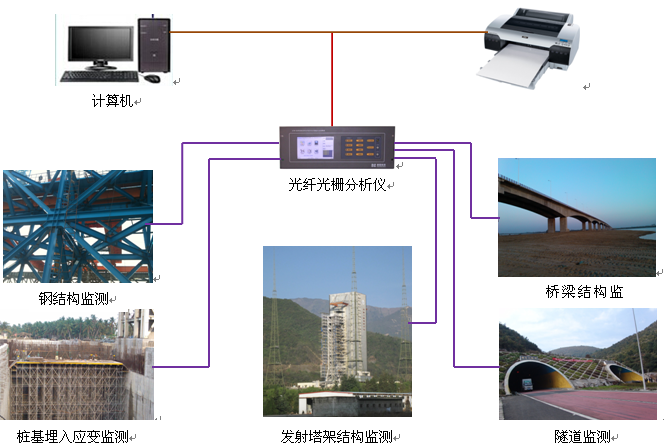
Application field
Bridge, dam and other structure surface strain monitoring or embedded steel strain monitoring;
Steel structure surface strain health monitoring;
Aerospace, ship structural health monitoring;
Health monitoring of strain, displacement and pressure in mine, tunnel, landslide and pile foundation;
A Fiber Bragg Grating (FBG) structural monitoring system can be designed to monitor parameters such as strain, displacement, pressure, temperature, and other structural responses, depending on the sensors and system configuration used.
For bridges, dams, tunnels, buildings, steel structures, mines, and other critical infrastructure, the monitoring system can provide long-term data on how the structure responds to loads and environmental changes.
The specific parameters to be monitored should be determined according to the structure type, potential failure modes, and project objectives.
Structural loading, settlement, deformation, cracking, or other changes may alter the strain distribution at critical locations.
FBG sensors installed on or embedded within the structure measure these strain changes over time. By comparing data from different locations and different periods, engineers can identify abnormal changes and evaluate whether a particular area requires further investigation.
The system therefore provides continuous structural response data rather than relying only on periodic visual inspection.
In some cases, changes in strain may develop before obvious external damage becomes visible.
Continuous monitoring allows engineers to observe whether strain at a critical location is increasing, remaining stable, or changing abnormally over time.
An abnormal strain trend does not automatically mean that structural failure is occurring, but it can provide an early indication that a particular area requires engineering evaluation or additional inspection.
FBG monitoring can be applied to a wide range of civil, industrial, geotechnical, and specialized structures.
Typical applications include bridges, dams, tunnels, buildings, steel structures, mines, slopes, pile foundations, hydropower facilities, aerospace structures, and ships.
The sensing arrangement should be customized according to the structural form, materials, loading conditions, monitoring objectives, and critical locations of each project.
Yes. FBG sensors can be surface-mounted on existing structural components when the installation conditions allow.
For existing bridges, dams, buildings, tunnels, steel structures, and other assets, engineers can first identify critical monitoring locations and then design the sensor installation and fiber routing accordingly.
The installation method must ensure that structural strain is transferred reliably to the sensor while providing adequate mechanical and environmental protection for long-term operation.
Yes. For new structures, FBG sensors can be incorporated into the construction process and embedded in concrete or installed with reinforcing steel and other structural components.
Embedding sensors during construction can provide valuable long-term information from locations that may become inaccessible after the structure is completed.
Because embedded sensors may be difficult or impossible to replace later, sensor selection, installation quality, cable protection, routing, and system redundancy should be carefully considered during the design stage.
Yes, but the sensor installation and monitoring strategy are different.
For concrete structures, sensors may be embedded during construction or installed on accessible surfaces. For reinforced concrete projects, sensors can also be designed to monitor strain associated with reinforcement or critical structural sections.
For steel structures, sensors can be attached to selected structural members to monitor strain changes caused by loading, deformation, fatigue, or other structural responses.
The sensor packaging and installation method should be selected according to the material and monitoring objective.
Sensor locations should be determined by structural engineering requirements rather than simply installing sensors at equal intervals.
Typical monitoring locations may include high-stress areas, critical load-bearing members, joints, supports, sections susceptible to deformation, areas with known defects, and locations identified through structural analysis.
For complex projects, structural drawings, load conditions, historical inspection records, and engineering calculations should be reviewed before determining the monitoring layout.
There is no fixed number that applies to every project.
The required number of sensors depends on the size and complexity of the structure, monitoring parameters, critical locations, expected deformation modes, required spatial coverage, and project budget.
A bridge monitoring project, for example, may require a very different sensor arrangement from a dam, tunnel, building, or foundation monitoring project.
The objective is not to install as many sensors as possible, but to place sufficient sensors at meaningful locations to obtain useful structural information.
Yes. One of the important advantages of FBG technology is that multiple sensing points can be multiplexed along optical fiber and connected to an interrogation system.
This can reduce the amount of field cabling compared with systems that require separate electrical wiring for every individual sensor.
The number of sensors that can be connected depends on the grating configuration, wavelength allocation, interrogator capability, required sampling rate, and overall system architecture.
FBG wavelength can respond to both mechanical strain and temperature, so temperature effects must be considered when accurate strain measurement is required.
Depending on the project, temperature compensation can be achieved through dedicated temperature sensors, strain-decoupled reference sensors, paired sensor arrangements, calibration methods, or software compensation.
The appropriate method depends on the required accuracy, environmental conditions, sensor packaging, and monitoring configuration.
For long-term structural monitoring, temperature compensation should be considered during system design rather than treated as an afterthought.
Depending on the sensor type, interrogator, and sampling configuration, FBG systems can be used for different types of structural monitoring.
Long-term or relatively slow measurements can be used to observe strain, settlement, deformation, and structural trends.
Higher-speed configurations can be designed for dynamic structural responses such as vibration, impact, or rapidly changing loads.
The required sampling rate should therefore be defined according to the events the project needs to capture.
Yes. Alarm and warning functions can be configured according to the project requirements.
The monitoring platform can compare measured values with predefined thresholds or other evaluation criteria and generate warnings when abnormal conditions are detected.
For structural health monitoring, however, alarm criteria should not be based only on one universal strain value. They should be determined according to structural design, material properties, engineering standards, normal operating behavior, and project-specific safety requirements.
Structures naturally respond to temperature, traffic, wind, water level, operational loads, and other environmental conditions.
For this reason, a change in sensor data does not automatically indicate structural damage.
Long-term monitoring helps establish the normal behavior of the structure under different operating and environmental conditions. Engineers can then compare new data with historical patterns and evaluate abnormal changes based on magnitude, duration, location, correlation between sensors, and operating conditions.
This is one of the main advantages of collecting continuous monitoring data over time.
FBG monitoring should normally be considered a complement to structural inspection rather than a complete replacement.
The monitoring system provides continuous quantitative data from selected locations, while visual inspection, non-destructive testing, engineering assessment, and other methods provide additional information about structural condition.
A more effective approach is to use continuous monitoring to identify abnormal locations or trends and then carry out targeted inspections or engineering evaluations.
The impact depends on the sensor network architecture, fiber routing, sensor arrangement, and location of the damage.
For critical projects, reliability should be considered during the design stage through appropriate cable protection, routing, connector management, and, where necessary, redundant sensing paths or spare channels.
For embedded systems in particular, physical protection during construction is extremely important because sensors may be difficult to access after the structure is completed.
Optical fiber sensors have strong resistance to electromagnetic interference because the sensing element operates optically rather than relying on electrical signals at the measurement point.
This makes FBG technology useful in many environments where electromagnetic interference may affect conventional electrical sensors.
However, long-term reliability still depends on appropriate sensor packaging, cable protection, moisture resistance, mechanical protection, and installation design for the specific environment.
Yes. Integration can be designed according to the existing monitoring platform, communication architecture, and interface requirements.
Strain, temperature, displacement, alarm information, historical trends, and other monitoring data can be transferred to a centralized structural health monitoring or asset management platform.
For projects requiring integration with an existing system, interface requirements, data formats, communication protocols, sampling rates, and alarm logic should be defined during the system design stage.
FBG sensing technology is suitable for long-term structural monitoring, but the service life of the complete system depends on more than the optical sensor itself.
Sensor packaging, installation quality, fiber cable protection, connectors, field environment, interrogator reliability, maintenance, and data management all affect long-term system performance.
For infrastructure expected to operate for many years, long-term maintainability should therefore be considered from the beginning of the project.
A preliminary design normally requires structural drawings, structure type and materials, dimensions, critical load-bearing components, operating conditions, known risk areas, historical defects or inspection results, and the parameters that need to be monitored.
It is also important to define whether the project requires strain, displacement, pressure, temperature, vibration, impact, or multiple parameters.
For an existing structure, information about accessibility, available cable routes, existing monitoring systems, installation restrictions, and integration requirements is also valuable.
Based on these inputs, engineers can determine sensor types, monitoring locations, sensor density, fiber routing, interrogation equipment, sampling requirements, alarm strategy, data platform, and installation method.
Shatuo Hydropower Station Dam Monitoring, Guizhou Province
Shenxigou Hydropower Station Dam Monitoring, Sichuan Province
Building Foundation Pit Monitoring at Institute 54
Foshan Gymnasium Structural Health Monitoring, Guangdong Province
Qinglai Expressway Subgrade Testing, Shandong Province
 Sales line:4008-555-919
 Contact address:Room 302, Floor 3, Building No. 3, No. 38 Courtyard, Linfeng'er Road, Haidian District, Beijing
 E-mail:market@dsc.net.cn Contact phone number: 010-82403194 Mobile phone number:15201662379
