A cable distributed fiber optic temperature measurement system (DTS) monitors the temperature distribution along power cables using the fiber itself as the sensor, catching overheating faults before they cause outages or fires. It is the standard modern approach to cable thermal supervision.
How it works. The system combines the Raman scattering effect with optical time domain reflectometry (OTDR). Laser pulses travelling in the fiber generate Raman backscatter whose Anti-Stokes component is strongly temperature-dependent; measuring the Anti-Stokes to Stokes intensity ratio yields the temperature profile, while OTDR timing precisely locates any temperature change along the cable.
System composition. The measuring fiber is mounted directly on the cable surface or inside it and serves as both sensor and transmission medium; a high-power laser source excites the Raman scatter; photodetectors convert the backscattered light into electrical signals; a signal processing unit computes the temperature data; and the control host runs system control, data analysis and alarm functions.
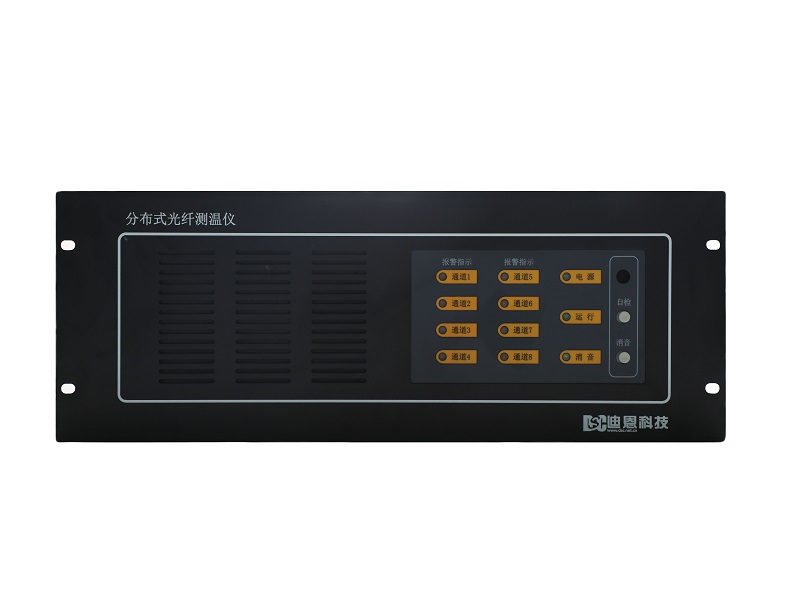
Technical characteristics. Temperature resolution reaches 0.1℃ or better; a single channel monitors tens of kilometers, covering large cable networks; the system watches the cables 24 hours a day without interruption; OTDR positioning pinpoints the exact location of anomalies for fast fault-finding; and the fiber sensor is immune to electromagnetic interference, corrosion and high temperature in any cable environment.
Cable DTS is widely applied to transmission cables, plant cable routes and tunnel cable systems. DSC provides complete cable monitoring packages based on the DSC-DTSmK-nC DTS host with matched sensing cable - contact us with your cable route length and load profile for a system proposal.

