Distributed fiber optic online temperature sensing measures temperature through the optical properties of the fiber itself - how light intensity, phase and wavelength respond to temperature - and this article details its system composition and working principle.
System composition. The light source is a stable, narrow-linewidth pulsed laser (semiconductor or erbium-doped fiber laser), with wavelength selected to match the fiber type and application environment. The optical transceiver unit controls pulse timing, separates launched and backscattered light and converts scatter into electrical signals. The sensing cable is the distributed measurement medium, chosen as multimode, single-mode or specialty-coated fiber according to environment and performance requirements. The signal processing unit amplifies, filters and digitizes the detector output and computes the temperature profile, and a data management layer with dedicated software handles storage, visualization, trending and alarms. Power, protection and calibration facilities complete the installation.
Working principle. The pulsed laser launches a wavelength-stable pulse into the fiber. As it travels, three scattering effects arise: Rayleigh, Raman and Brillouin - and it is the Raman backscatter that carries the temperature information. Part of the backscatter returns to the photodetector, which converts it for time-domain analysis.
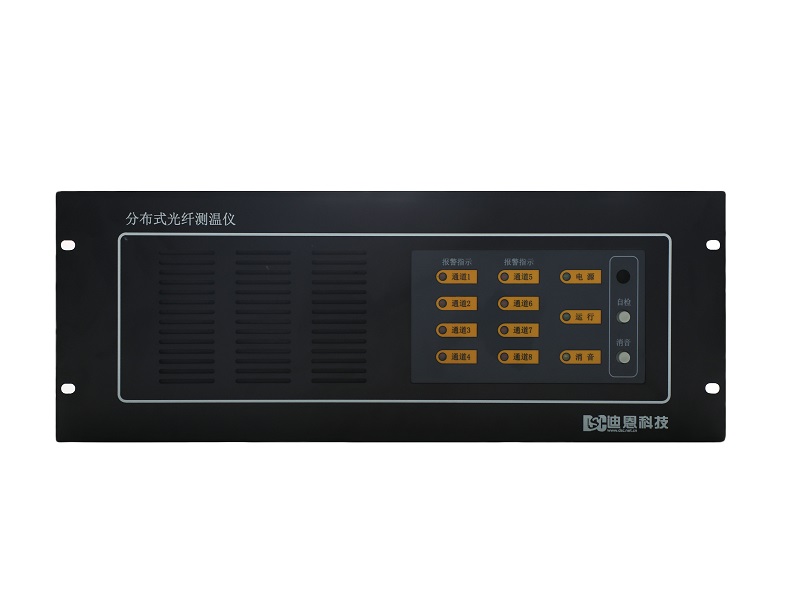
From scatter to temperature. The Raman backscatter consists of Stokes and Anti-Stokes components whose intensity ratio depends exponentially on temperature. By measuring this ratio at every time-delay bin, the system converts the backscatter power distribution into a calibrated temperature profile along the entire fiber - thousands of measurement points, updated in real time.
Understanding this principle explains the technology's hallmark features: no powered sensors in the field, complete electromagnetic immunity, and true distributed coverage. DSC builds its DTS host units on this proven measurement chain - contact us for a technical deep-dive on your application.

