The fiber distributed temperature sensing (DTS) system is a temperature monitoring solution built on fiber sensing technology. This article details its principle and characteristics.
System principle. The system works on the Raman scattering effect and optical time domain reflectometry (OTDR). A laser pulse travelling through the fiber collides inelastically with the fiber molecules, producing Raman scatter consisting of Stokes and Anti-Stokes components. The intensity ratio of the two depends exponentially on temperature; measuring that ratio and locating the scatter point with OTDR yields the temperature distribution along the entire fiber.
System characteristics. Distributed measurement: continuous temperature coverage along the fiber with no blind spots and wide reach. High accuracy and resolution: temperature accuracy typically ±0.1℃ to ±0.5℃, spatial resolution of 0.5 m to 4 m, reflecting the temperature distribution in fine detail. Real-time monitoring and warning with configurable thresholds. Immunity to electromagnetic interference and intrinsic safety for the harshest environments. And a measurement chain with no powered components in the field, keeping the monitored area untouched.
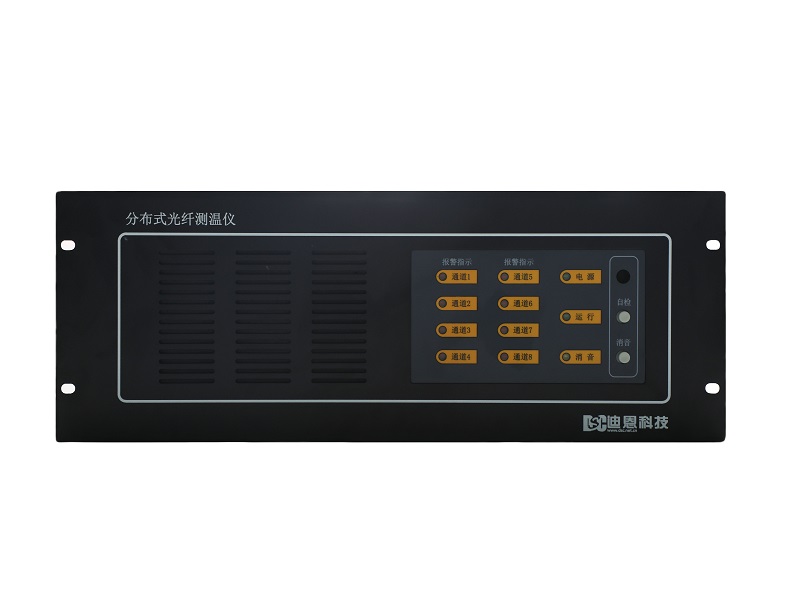
These characteristics make the fiber DTS system the standard choice for cables, pipelines, tunnels and industrial temperature monitoring. DSC's DSC-DTSmK-nC series implements the full measurement chain with application engineering support - contact us to configure a system.

