Logistics warehouses concentrate three fire hazards under one roof: dense storage of combustible goods, unpredictable mixed cargo including dangerous goods, and racking that grows taller every year. The Fiber Bragg Grating (FBG) linear heat detector addresses all three by watching temperature continuously along every rack aisle, giving warehouse operators an early-warning layer that works before smoke ever reaches a ceiling-mounted detector.
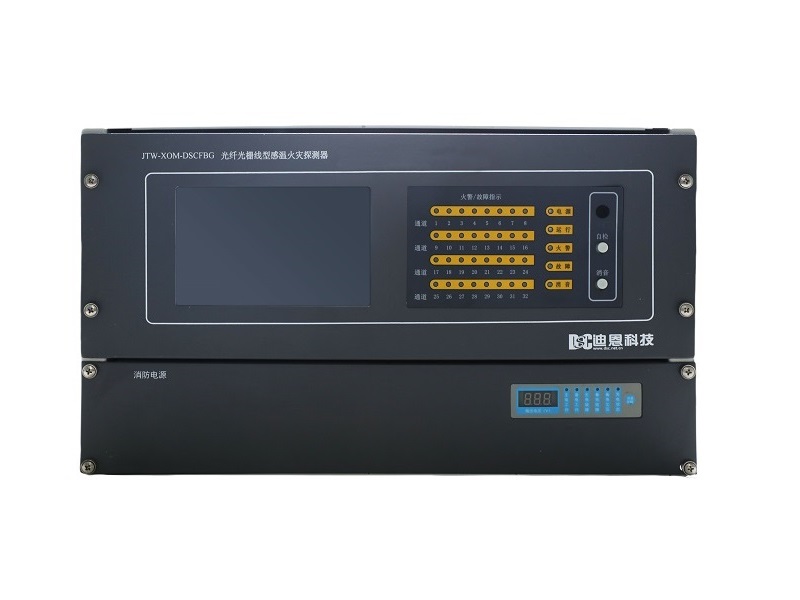
Real-time monitoring and early warning. The FBG sensing line reports temperature at every grating position in real time. An overheating forklift charger, a failing battery pack or a smoldering carton is detected at the abnormal-heating stage - long before flames - so staff can intervene while the event is still manageable and goods are still salvageable.
High precision over large distances. One detector line covers a full rack aisle or ceiling zone of tens to hundreds of meters, with every measurement point individually identified. This pinpointing capability means the response team knows exactly which bay is heating up, cutting response time and reducing both false alarms and missed events.
Built for harsh warehouse conditions. Dust, humidity and temperature swings that disable smoke detectors barely affect the all-glass FBG sensing network. It carries no current at the sensing points, tolerates electromagnetic interference from chargers and conveyor drives, and resists corrosion - all essential properties in an environment where equipment runs around the clock.
Integration with fire protection systems. The detector outputs standard alarm signals, so it links directly to sprinklers, smoke exhaust, paging and access-control systems: on confirmation of an event, the affected zone can be extinguished or cut off automatically while evacuation routes stay open. Warehouses with high-value electrical storage typically combine the FBG linear heat detector with an aspirating smoke detector to cover both temperature and smoke signatures in one scheme.

