The measurement principle of a fiber Bragg grating sensing system is wavelength modulation: the measurand moves the grating's reflected wavelength, and the system reads the movement. This article walks the complete signal path step by step - from source emission to grating reflection to wavelength shift to demodulated data - and shows why this encoding gives FBG systems their precision edge.
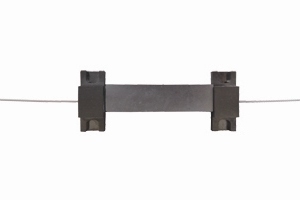
Step 1: the source emits broadband light. The system source launches continuous broadband light through the transmission fiber toward the FBG sensor. Because FBG sensing encodes measurements in wavelength, the source must supply a wide, stable spectrum covering every grating in the array.
Step 2: the grating reflects selectively. The FBG reflects wavelengths that match its internal period, producing a narrow reflection band whose center wavelength depends on the grating period and the effective refractive index of the fiber core. This selective reflection is the built-in measurement reference.
Step 3: the measurand shifts the wavelength. When temperature, strain or another physical quantity acts on the grating, the period or refractive index changes, moving the reflected wavelength. Temperature rise, for example, increases the core's effective refractive index and shifts the reflection accordingly. The shift corresponds one-to-one with the measurand - an absolute code immune to intensity loss along the fiber.
Step 4: demodulation converts shift to data. The reflected light returns to the interrogation unit, which tracks each wavelength position and converts shifts into calibrated engineering values. Demodulation resolution and speed set the system's final accuracy and response, which is why the interrogation instrument - such as the DSC-FBG-XA fiber Bragg grating analyzer - is the performance-critical component.
Why the principle wins in the field. Wavelength encoding delivers high precision, high sensitivity and complete electromagnetic immunity, and it multiplexes naturally: many gratings share one fiber line. These properties carry FBG systems into aerospace, petrochemical, rail transit and large-bridge and building health monitoring, with the FBG structural monitoring system as the production embodiment at infrastructure scale.

