A complete fiber Bragg grating sensing system is best understood as seven cooperating parts: light source, FBG sensors, transmission fiber, demodulation unit, photoelectric conversion and signal processing, data acquisition and control, and the user interface. Walk the chain once and every FBG datasheet - including those of the DSC-FBG-XA fiber Bragg grating analyzer - becomes easy to read.
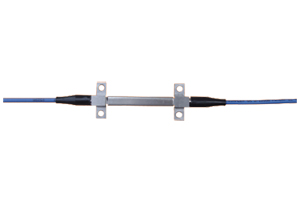
1. Light source. The chain starts here: the source provides the stable spectral input the system interrogates with. Broadband sources such as superluminescent diodes (SLD) and tunable sources are the standard choices, each covering the spectral range the grating array needs.
2. Fiber Bragg grating sensors. The core of the system: specially designed fiber carrying written grating structures. When temperature, strain or another quantity changes, the grating's refractive index or length changes, shifting the reflected wavelength - a one-to-one correspondence that makes the wavelength shift a direct readout of the measurand.
3. Transmission fiber. The connecting medium carries source light to the sensors and reflections back to the demodulation unit. Selection weighs transmission loss, dispersion characteristics and environmental adaptability - the properties that decide how far and how faithfully signals travel.
4. Demodulation unit. The precision engine: it converts the returning optical signals into electrical form and recovers each grating's wavelength shift. Its resolution and stability bound the entire system's measurement performance.
5. Photoelectric conversion and signal processing. Downstream of demodulation, this stage converts, conditions and computes the signals into calibrated engineering values - the bridge between raw optics and usable data.
6. Data acquisition and control system. The stage collects processed data for storage, display or transmission, and controls the source, demodulation parameters and system operations - the automation layer that lets the system run unattended and intelligently.
7. User interface and display equipment. The human layer: displaying measurement results and system status, and providing parameter setting and data query for operators. The seven parts together deliver high-precision measurement and real-time monitoring, and in field deployments they are packaged into products such as the FBG structural monitoring system and the grating-array shaft and guide-rail deformation monitoring system.

