What is the error range of a dense distributed fiber optic temperature measurement system? The honest answer is that it depends on measurable factors - internal component heat dissipation, measured temperature, fiber position, reference-temperature measurement error and system noise - and that the dominant factors have been quantified in controlled research. This article walks the error sources, the measured numbers, and the calibration recommendation.
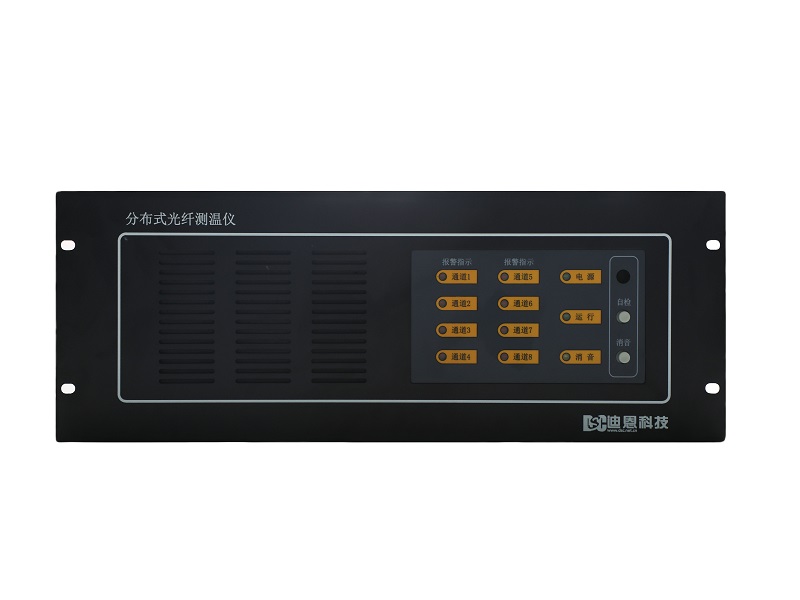
Factor 1: internal component heat dissipation. When the distributed fiber temperature sensor sits in a constant-temperature room, the system's internal components dissipate heat, pushing the system's reference temperature above the ambient temperature. The measured effect is small and stable: as the reference temperature varies from 25 to 35 degrees Celsius, the measurement error changes from 0.3756 to 0.3491 degrees Celsius at a measured temperature of 0 degrees (a change of 0.0265 degrees); from 0.5257 to 0.4886 degrees at 50 degrees measured (0.0371 degrees change); and from 0.7009 to 0.6515 degrees at 100 degrees measured (0.0494 degrees change). All three error changes stay below 0.05 degrees Celsius - the component-heat effect is real but tightly bounded.
Factor 2: measured temperature level. The measurement error grows with the measured temperature - higher temperatures produce proportionally larger deviations, which is why high-temperature applications need calibration points at their operating range rather than only at ambient.
Factor 3: fiber position and system noise. Position along the fiber affects error through signal attenuation over distance, and system noise sets the floor on resolvable change - both are engineered in the interrogation hardware, such as the DTS host units, and both belong in the accuracy specification of any deployment.
Calibration recommendation. To reduce the measurement error caused by component heat dissipation, the reference temperature should be maintained within 30 plus-or-minus 5 degrees Celsius under calibration conditions. In application, select the system for the need and calibrate it accurately - that is what secures the measurement precision the specification promises.
Summary. The error range of dense distributed fiber temperature measurement is a genuinely multi-factor question. Evaluated against the quantified factors - with reference temperature controlled in calibration and the switchgear DTS monitoring system class of hardware specified honestly - the achievable precision is predictable and manageable.

