The fiber Bragg grating temperature sensing system turns a passive optical fiber into an array of precise temperature sensors. An FBG is a narrowband wavelength-selective reflector: broadband light sent down the fiber returns, from each grating, a narrow reflection whose wavelength moves with temperature. Detecting those wavelength shifts - across many serial gratings - is the whole system, and it outperforms electronic temperature sensing wherever electromagnetic interference, corrosion or distance is a problem.
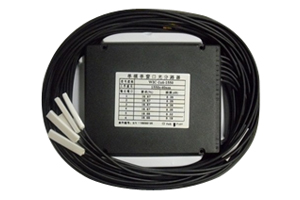
Working principle. The FBG reflects a narrow band whose wavelength is a function of the grating's temperature and strain state. In a temperature system the gratings are thermally coupled to the measurement points and mechanically isolated from strain, so wavelength shift maps cleanly to temperature. The reflected light is detected, demodulated and converted into a calibrated temperature value per grating.
System composition. A typical architecture includes a tunable light source, fiber splitters, circulators, a quasi-distributed string of serial FBG sensors, photodetectors and a data-acquisition card. Source light is split into parallel channels, each channel carrying multiple serial gratings to form a quasi-distributed sensing network; the detectors and acquisition electronics process all channels in parallel.
Technical characteristics. The system provides high measurement precision and stability, inherent immunity to electromagnetic interference, corrosion resistance from its all-dielectric construction, and true multi-point quasi-distributed measurement on a single fiber - several gratings multiplexed along one line, each independently addressable.
Applications and trends. Deployed systems monitor bridges, dams and oil facilities, protect storage tanks, and watch high-voltage switchgear and power cables in power, metallurgical and chemical industries; geodynamic applications include seismic and volcano monitoring. As FBG technology matures and costs decline, systems are heading toward higher precision, higher stability and wider measurement ranges. The FBG-based switchgear temperature online monitoring system is the flagship power-industry deployment, and the DSC-FBG-XA fiber Bragg grating analyzer provides the interrogation hardware for custom multi-channel temperature networks.

