The principle of a fiber Bragg grating (FBG) sensing system comes down to one equation: the Bragg wavelength equals twice the product of the fiber core's effective refractive index and the grating period. Everything an FBG system measures - temperature, stress, strain - enters the measurement by moving one of those two factors. This article explains the physics and the fabrication that make it work.
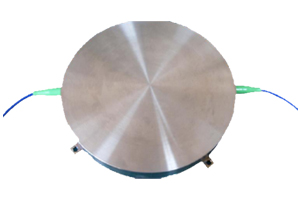
What a fiber Bragg grating is. An FBG is a periodic modulation of the refractive index written into the fiber core. The periodic structure reflects a specific narrow wavelength band strongly while transmitting the rest - a built-in wavelength filter. Gratings are fabricated by exploiting the photosensitivity of the fiber material: ultraviolet exposure through a phase mask writes an interference pattern into the core, creating a permanent phase grating.
The Bragg wavelength relation. The reflected Bragg wavelength depends on the effective core-mode refractive index and the grating period. When an external physical quantity changes - temperature expanding the grating period, strain altering both period and refractive index - the Bragg wavelength shifts proportionally. Measuring the shift therefore recovers the physical quantity, with the wavelength acting as an absolute, drift-resistant code for the measurement.
From optics to data. Broadband light travels down the fiber to the grating array; each grating returns its narrow reflection, shifted by whatever the environment has done to it. The interrogation unit tracks each wavelength position and converts it into calibrated engineering units for temperature or strain - without any electrical signal at the measurement point.
Why the principle matters in practice. Because the sensing element is passive glass, FBG systems are immune to electromagnetic interference, highly sensitive, small, lightweight and low in cost. And because gratings couple naturally into fiber, many can be serially multiplexed along a single line into a quasi-distributed array. These properties drive the wide adoption in large civil structures, aerospace and transportation described in the FBG structural monitoring system applications, with the DSC-FBG-XA fiber Bragg grating analyzer as the standard interrogation instrument built on this principle.

