The fiber Bragg grating sensing demodulation system is where optical data becomes engineering data. The sensors do the sensing, but it is the demodulation system - wideband source, splitter, sensor array, combiner and demodulator - that converts wavelength shifts into calibrated temperature, strain or pressure values. This article explains how that conversion chain is built and what it is used for.
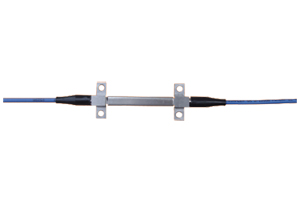
Basic principle. Demodulation is anchored to the Bragg wavelength property of the grating: an external physical quantity changes the fiber's refractive index or length, which shifts the wavelength of strongest reflection. That shift has a defined, stable relationship to the measurand, so tracking the wavelength recovers the physical value with high precision.
System composition. Five stages form the chain. The wideband source emits the interrogation spectrum. The splitter divides it into multiple paths, each illuminating a different sensor line. The FBG sensor array senses the physical quantities along those lines. The combiner merges the reflected signals back into one path, and the demodulator converts the merged optical signal into electrical or digital data, tracking every grating's wavelength position in parallel.
What demodulation accuracy decides. The demodulator's wavelength resolution, scan rate and stability set the ceiling for the whole system: its precision bounds measurement accuracy, its speed bounds response time, and its stability bounds long-term drift. This is why interrogation hardware - such as the DSC-FBG-XA fiber Bragg grating analyzer - is the most performance-critical purchase in any FBG deployment.
Applications. Demodulation systems serve structural health monitoring of bridges and large buildings, temperature monitoring of power equipment such as switchgear and transformers, geophysical observation including seismic monitoring and gas detection, and industrial production monitoring of machinery, processes and product quality. In power applications they pair with the FBG-based switchgear temperature online monitoring system; in infrastructure with the FBG structural monitoring system.
Development trends. Demodulation technology is moving toward higher precision, broader applicability, smaller footprints and greater intelligence. As instruments shrink and smart processing grows, demodulation systems will keep extending FBG sensing into new fields and new deployment models.

