The fiber Bragg grating pressure sensing system measures pressure through the same physics that measures temperature and strain: applied pressure changes the grating's pitch and refractive index, shifting the reflected Bragg wavelength. What distinguishes pressure sensing is the mechanical transducer design that converts pressure into a calibrated, linear wavelength shift - and the harsh-environment immunity that makes FBG the preferred choice for pipelines, tanks and downhole applications.
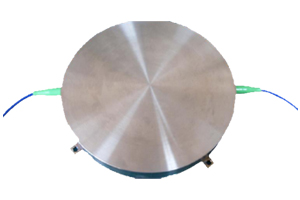
System composition. Three blocks form the system: a broadband light source providing the interrogation energy; the FBG pressure sensor, whose transducer mechanics couple the applied pressure to the grating; and the signal demodulation system that tracks the wavelength shift in real time and converts it into pressure readings.
Transducer principle. An FBG is a periodic refractive-index structure written into the fiber. When pressure acts on the sensor, the grating's spacing changes, shifting the wavelength of the reflected light. The shift is measured by interferometric or other optical detection methods and, because the wavelength change relates directly to the sensor's material properties and geometry, the pressure value is recovered from the wavelength with a stable, calibratable relationship.
Key advantages. The sensor is passive and non-electric at the measurement point, so the system is immune to electromagnetic interference and intrinsically safe in hazardous atmospheres. Sensitivity and precision reach levels adequate for industrial process and structural requirements, the fiber path supports long-distance transmission to remote interrogators, and the sensors tolerate corrosion and extreme temperatures that defeat electronic pressure cells.
Application fields. Oil and gas operations monitor pipeline and storage-tank pressure and downhole conditions; the power industry watches hydraulic and cooling systems to keep plant equipment inside safe pressure envelopes; and aerospace programs apply FBG pressure and strain sensing to aircraft and rocket structures for flight safety. In power-sector monitoring schemes, FBG pressure sensing typically complements the FBG-based switchgear temperature online monitoring system, and in infrastructure the FBG structural monitoring system integrates strain and pressure channels on the same interrogation platform.
Development trends. Progress is pushing measurement precision higher, interference immunity stronger and application coverage wider, while micro-nano fabrication is shrinking sensors and enabling integration - trends that will keep extending FBG pressure sensing into compact, multi-parameter sensing nodes.

