The fiber Bragg grating sensing experimental system is the laboratory-grade version of FBG technology - the platform on which physics, electronics and communications programs teach wavelength-encoded measurement, and on which researchers prototype sensing schemes before field deployment. This article covers its construction, operating principle and a representative experiment.
System composition. Five parts form the experimental platform. The system source provides the optical signal - continuous or pulsed-modulated - and its resolution, bandwidth and noise shape the whole system's spectral performance. Broadband sources (BBS) and superluminescent diode (SLD) designs are the standard choice; distributed-feedback lasers and erbium-doped fiber lasers serve experiments demanding higher precision. The FBG sensor or sensor array performs the sensing, in single-point or networked multi-grating configurations. The demodulation instrument converts the wavelength information stored in the gratings into electrical signals, and the detector receives and converts the demodulated optical signal into measurable electrical output.
Working principle. The experiment follows the canonical FBG chain: broadband light interrogates the grating array; each grating reflects a wavelength determined by its temperature and strain state; the demodulator tracks every reflected wavelength; and the processing electronics convert shifts into engineering values. Students and researchers observe the entire physics - encoding, transmission, demodulation, calibration - in one benchtop setup.
What the platform teaches. Because every stage is observable, the experimental system is the standard vehicle for teaching optoelectronic measurement, sensor calibration and signal-chain design. It also serves applied research: grating fabrication parameters, demodulation algorithms and transducer mechanics are all tunable variables on one platform.
Representative experiment: high-voltage measurement. A well-known application experiment measures high voltage indirectly. The apparatus combines a sensing unit - an FBG arrangement that senses the strain or temperature change induced by the voltage effect - with a signal-processing unit that converts the optical output into electrical data for analysis. The exercise demonstrates how FBG platforms extend to measurands that have no direct optical coupling, through engineered transduction.
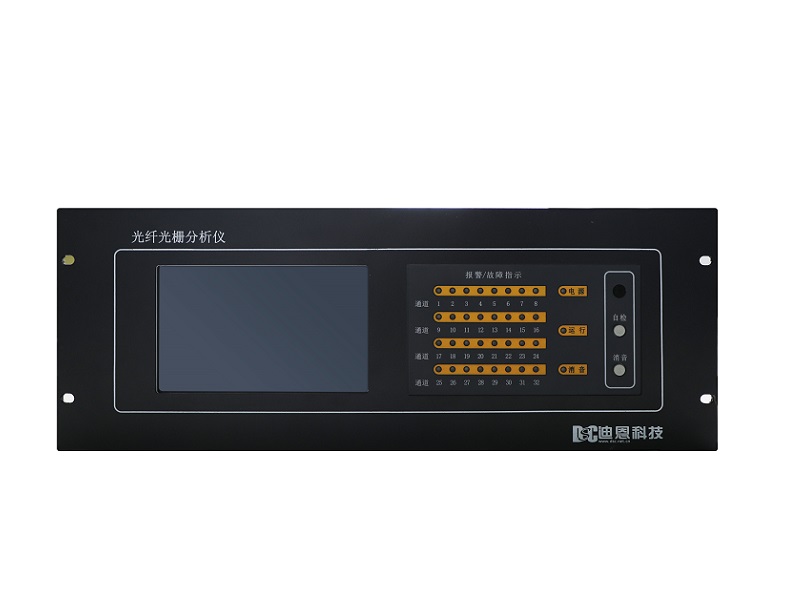
For laboratories building such platforms, the DSC-FBG-XA fiber Bragg grating analyzer provides the demodulation instrument, and the FBG structural monitoring system shows how the same benchtop principles scale to full field deployments.

