The fiber Bragg grating sensor system measures temperature, strain, pressure and vibration with wavelength-encoded precision - and its track record in bridges and aerospace shows what that precision is worth in service. This article walks the complete system from light source to data output, then looks at where deployed systems have earned their keep.
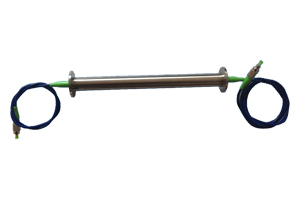
System composition. Five blocks form the system. The source - typically a broadband source (BBS) or superluminescent diode (SLD) - provides the stable optical signal. The FBG sensor, the system's core, senses external quantities through wavelength modulation. The coupler injects source light into the sensor line and routes the reflected light out to the demodulation instrument. The demodulator converts reflections into electrical signals and recovers the wavelength shifts. The data processing unit analyzes the demodulated signals into final measurement results, trends and alarms.
Working principle. An external quantity - temperature, strain, pressure or vibration - changes the grating's refractive index or pitch, shifting the reflected wavelength. The shift corresponds one-to-one with the measurand, so the demodulated wavelength directly yields the physical value at each sensing point, absolutely encoded and immune to signal-path drift.
Performance characteristics. The system delivers high precision and sensitivity, complete electromagnetic immunity, and passive operation at every sensing point. Because gratings multiplex along one fiber, a single system covers dozens of points - and because the fiber is durable glass, the system survives corrosion, moisture and temperature extremes in long-term unattended service.
Deployment cases. In large-bridge structural health monitoring, FBG sensor systems installed at critical locations track strain and temperature in real time, catching structural damage precursors before they become safety incidents. In aerospace, the same systems monitor aircraft and rocket structures in flight-test and ground-test programs, feeding the safety cases for flight clearance. These deployments follow the architecture of the FBG structural monitoring system and the grating-array shaft and guide-rail deformation monitoring system, both built on the DSC-FBG-XA fiber Bragg grating analyzer interrogation platform.
Outlook. As fabrication costs fall and demodulation intelligence grows, FBG sensor systems are expanding from flagship infrastructure into wider industrial monitoring - with miniaturization and integration opening further application ranges.

