Reading a fiber Bragg grating sensing system composition diagram is the fastest way to understand the technology: five connected units - light source, sensors, demodulation, photoelectric transmission and information processing - show exactly how light in becomes data out. This article walks each unit of that diagram and how the units link together.
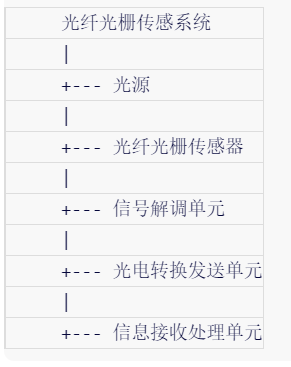
Light source. The source provides the system's stable optical signal. Common choices are the broadband source (BBS), the superluminescent diode (SLD) and the tunable source - the latter built from an amplified spontaneous emission source combined with a Fabry-Perot tunable filter, wavelength-calibrated by an F-P etalon to serve different measurement requirements.
FBG sensors. The sensing core uses wavelength modulation to convert measurands such as temperature and strain into reflections. Sensors work as single points or as serially multiplexed arrays on one fiber, the array configuration providing distributed measurement across many positions from one optical path.
Signal demodulation unit. The demodulation unit converts reflected optical signals into electrical signals and recovers the wavelength shifts. The principal techniques are filtering, interferometric and tunable narrowband source methods - the choice determines the system's precision, speed and cost profile.
Photoelectric conversion and transmission unit. This stage converts processed signals for transmission - over copper or fiber - ensuring accurate delivery of measurement data and enabling remote monitoring of the system from a control location.
Information receiving and processing unit. The final stage receives transmitted data, processes and analyzes it, and delivers real-time monitoring, alarm evaluation, data storage and post-analysis. Together the five units form the complete measurement chain shown in the composition diagram.
Configuration notes. Actual deployments vary with scenario: additional filters, amplifiers or multiplexers may be added to meet specific measurement needs, and system composition keeps evolving with technology. Practical implementations of this architecture include the DSC-FBG-XA fiber Bragg grating analyzer for interrogation and the FBG structural monitoring system for field deployments.

