The fiber Bragg grating temperature sensor system measures temperature with a precision and an environmental tolerance that electronic sensors struggle to match. Its accuracy rests on a physical fact - the Bragg wavelength moves predictably with temperature - and its deployment advantage rests on another: the sensor is passive glass, unaffected by the electromagnetic fields that corrupt electronic temperature measurement in power plants and industrial facilities.
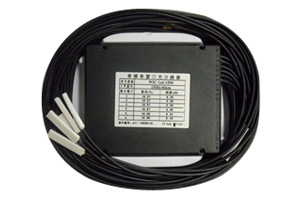
Working principle. When the temperature around an FBG changes, the grating's period or the core refractive index changes, shifting the reflected Bragg wavelength. Measuring the wavelength change before and after the physical change yields the temperature change - a direct, absolute encoding that needs no reference junction, no cold-junction compensation and no in-field recalibration.
Main advantages. Strong interference immunity: the sensor transmits wavelength signals, not intensity, so source drift, connector loss and fiber attenuation do not corrupt the reading, and there is no multi-value ambiguity. Quasi-distributed measurement: many gratings are written along one fiber, and each grating is tiny - giving dense multi-point measurement with high spatial resolution over a single line. Environmental adaptability: the sensor is passive, generates no heat and is unaffected by electromagnetic fields, and the all-silica construction resists corrosion - ideal for strong-EMI and chemically aggressive environments.
Typical specifications. Production temperature sensor systems specify measurement resolution on the order of 0.1 degrees Celsius, a center wavelength range of about 1525 to 1565 nm, insulation classes scaled to the application - from low-voltage equipment up to 110 kV class and above - and packaging options such as stainless-steel hermetic sealing or ceramic encapsulation matched to the installation environment.
Applications and outlook. Power equipment monitoring is the flagship deployment, led by the FBG-based switchgear temperature online monitoring system; chemical process vessels, civil structures and aerospace applications follow. As FBG costs decline, the technology is heading toward higher precision, wider measurement ranges, stronger interference immunity and easier installation - with the DSC-FBG-XA fiber Bragg grating analyzer as the standard interrogation platform across these deployments.

