Designing a fiber Bragg grating sensor system for a real application means matching three core building blocks - source, sensors and demodulation - to the physical reality of the site. This article explains the design decisions block by block, then maps the resulting system onto the industries where it runs in production: power, petrochemicals, dams, bridges, aerospace and shipping.
The broadband light source. The source provides the system's optical energy, and its quality defines the quality of every measurement. Because FBG sensing encodes data in wavelength, the source must offer wide bandwidth, strong output power and long-term stability to serve multi-point, multi-parameter distributed measurement. LED, laser-diode and rare-earth-doped sources cover the design spectrum from cost-optimized to precision-optimized systems.
The sensors. FBG sensors interrogate external measurands with the source's light wave, directly measuring temperature, strain and related quantities. Design choices at this level include grating count per line, center-wavelength allocation for multiplexing, and packaging matched to the installation environment.
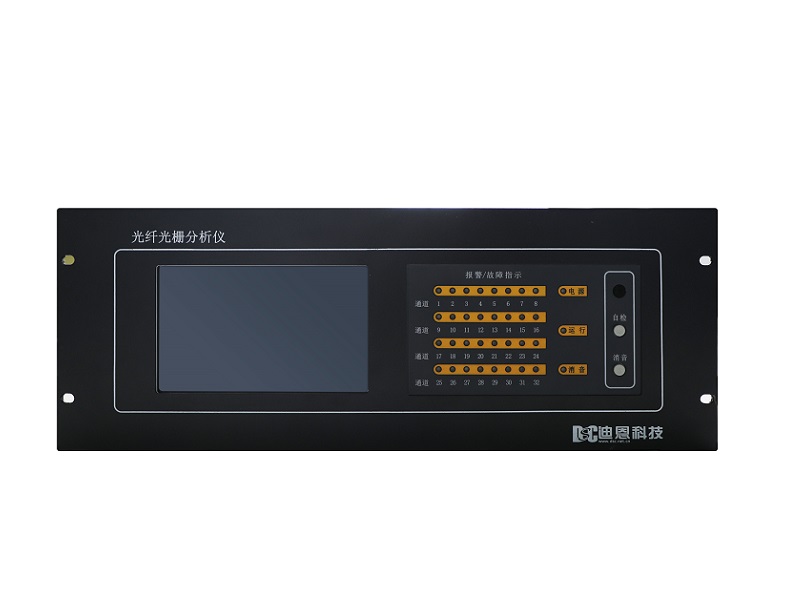
The demodulation system. Demodulation displays the sensed information in real time, split into an optical module that tracks each grating's center reflection wavelength and an electronic module that processes the converted signals into digital, user-readable output. Its precision and speed bound the whole system's performance, so instrument selection - such as the DSC-FBG-XA fiber Bragg grating analyzer - is the central design decision.
Industry mapping. The power industry applies FBG systems to monitor temperature changes and anomalies in electrical equipment, through deployments such as the FBG-based switchgear temperature online monitoring system. Dam monitoring uses them for deformation and seepage parameters; bridge health monitoring tracks strain and temperature grids; aerospace and shipping apply them to structural monitoring where weight and EMI immunity are decisive; and petrochemical facilities combine temperature, pressure and strain channels on one interrogation platform - the architecture the FBG structural monitoring system packages for infrastructure.
Development outlook. Falling costs are broadening adoption, while the technology heads toward higher precision, wider measurement ranges, stronger interference immunity and easier installation - and toward deep integration with IoT and big data for intelligent, networked monitoring and management.

