The distributed fiber Bragg grating sensing system is an optical sensor network that measures multiple optical parameters - frequency, phase, intensity - through the reflection and diffraction behavior of gratings distributed along a fiber. Its defining capability is spatial coverage: one line, many measurement points, every point individually identified. This article explains the principle, composition and application reach of the architecture.
System principle. The system exploits the grating's sensitivity to environmental change: an external physical quantity - temperature, stress, strain - alters the grating period or refractive index, shifting the reflected or transmitted wavelength. Measuring that shift in real time yields the physical quantity at each grating's position, giving the network its distributed measurement capability.
System composition. Four blocks form the network. The source provides the stable optical signal - broadband or laser. The FBG sensor array consists of multiple gratings, each corresponding to one measurement point along the fiber. The signal demodulation unit receives the array's optical returns and extracts the physical quantities through wavelength analysis. The data processing system then converts demodulated data into monitoring records, trends and alarms for the whole line.
What the architecture delivers. Because every grating is wavelength-addressed, the demodulator identifies each point independently - true quasi-distributed measurement with one interrogation channel serving the entire array. Combined with the fiber's electromagnetic immunity and passive sensing core, the architecture scales from a few points to hundreds along a single run.
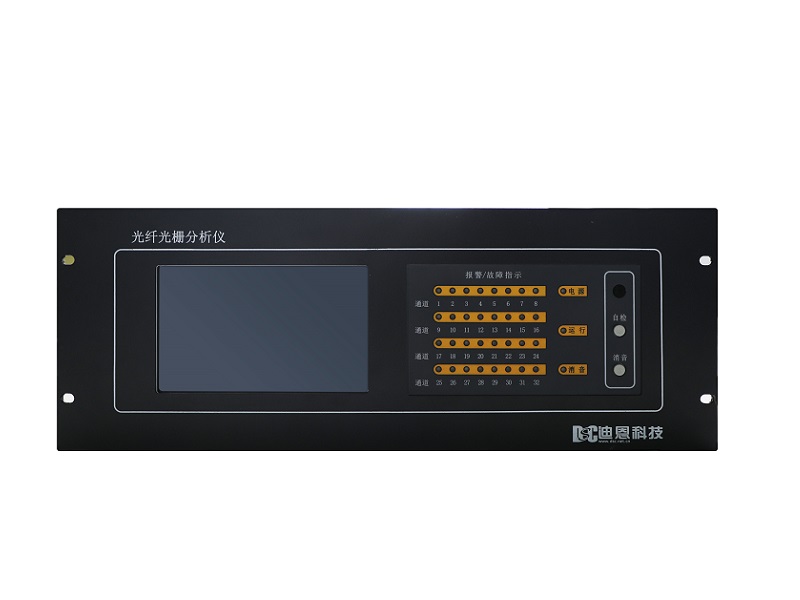
Application fields. Distributed FBG networks serve structural health monitoring of bridges, dams and buildings; electric power monitoring of cables and equipment; rail and transportation monitoring; safety systems for fire and overheating detection and power-cable surveillance; and even fiber communication itself - online production control of optical cable manufacturing and cable maintenance. Production embodiments include the FBG-based switchgear temperature online monitoring system and the FBG linear heat detector, both interrogated by instruments such as the DSC-FBG-XA fiber Bragg grating analyzer.
Development outlook. Higher sensitivity, higher resolution, wider measurement ranges and greater intelligence are the direction of travel, with new materials and processes lifting sensor performance and reliability further as the networks expand into new fields.

