The distributed fiber optic linear heat fire detector is a real-time, online, continuous temperature measurement system that uses optical fiber as both the sensing element and the signal transmission medium, monitoring temperature along the line and alarming on abnormal heat. This article explains the Raman-scattering principle behind it, the system's composition and its characteristic advantages.
Principle. The detector exploits the temperature sensitivity of scattered light in the fiber - principally Raman scattering - combined with optical time-domain reflectometry (OTDR). When a laser pulse travels down the fiber, it interacts with the fiber medium and produces backscattered Raman light: the anti-Stokes component is temperature-sensitive, the Stokes component is not. Measuring the intensity ratio of the two components yields the temperature at each point along the fiber - thousands of measurement points, located by the time-of-flight of the scattering, updated in real time.
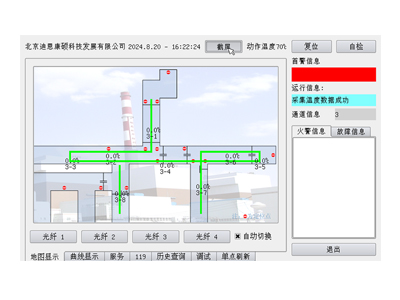
Main composition. Two parts form the system. The sensing fiber is both the sensitive element and the transmission medium, laid along the protected zone. The interrogation and processing unit launches the laser pulses, measures the Raman returns and converts them into a calibrated temperature profile with alarm logic attached - the hardware exemplified by the 3 km cabinet type, the 2.5 km wall-mounted type and the 10 km wall-mounted type linear heat detectors.
Characteristic advantages. Six properties define the technology: long measurement distance over a single fiber line; no measurement blind zones, because every meter of fiber is a sensor; real-time measurement, continuously updated; intrinsically safe explosion protection, since the sensing path carries no electricity; strong interference immunity against the electromagnetic noise of industrial sites; and precise location, pinpointing the hot spot along the line.
Where it wins. Long-distance, high-fire-risk spaces that people approach with difficulty - tunnels, cable galleries, tank farms, conveyor routes - are exactly where traditional point detectors fall short, and where the distributed fiber detector provides more comprehensive and reliable fire protection, deployed through systems such as the tunnel linear heat detection system.
Summary. The distributed fiber optic linear heat fire detector is a high-tech fire detection device based on fiber sensing, with long distance, no blind zones, real-time measurement, intrinsic safety, interference immunity and precise location as its signatures - a wide application prospect for fire monitoring and strong protection for fire safety.

